
Basic.Space LA returned to the Pacific Design Center last weekend, in a building more affectionately known as “the Blue Whale.” Frankly, that feels as apt a summary as any: the guests are slowly filtered through the glass tongue to be swept away into the jaws of art, fashion, & design.
I had attended their debut launch in 2025 to an eye feast of: A$AP Rocky’s Ray-Ban collection, Memphis Milano bookcases, ENORME telephones, and personal favorite - a 1965 Pontiac Vivant, with a gleaming baby-blue coat, parked beside the installation of Jean Prouvé’s Gas Station (1969). It was impossible not to love the excess of it all. So of course I came back.
The thesis behind what Basic.Space is doing is something that I can appreciate from a consumer’s lens. But for my inner art freak, it reminded me of what I dislike about the contemporary art & design scene - how people’s love of art can so easily be twisted into performance - though the crowd did provide ample material for my journal.
The Glade by Rick Owens Furniture
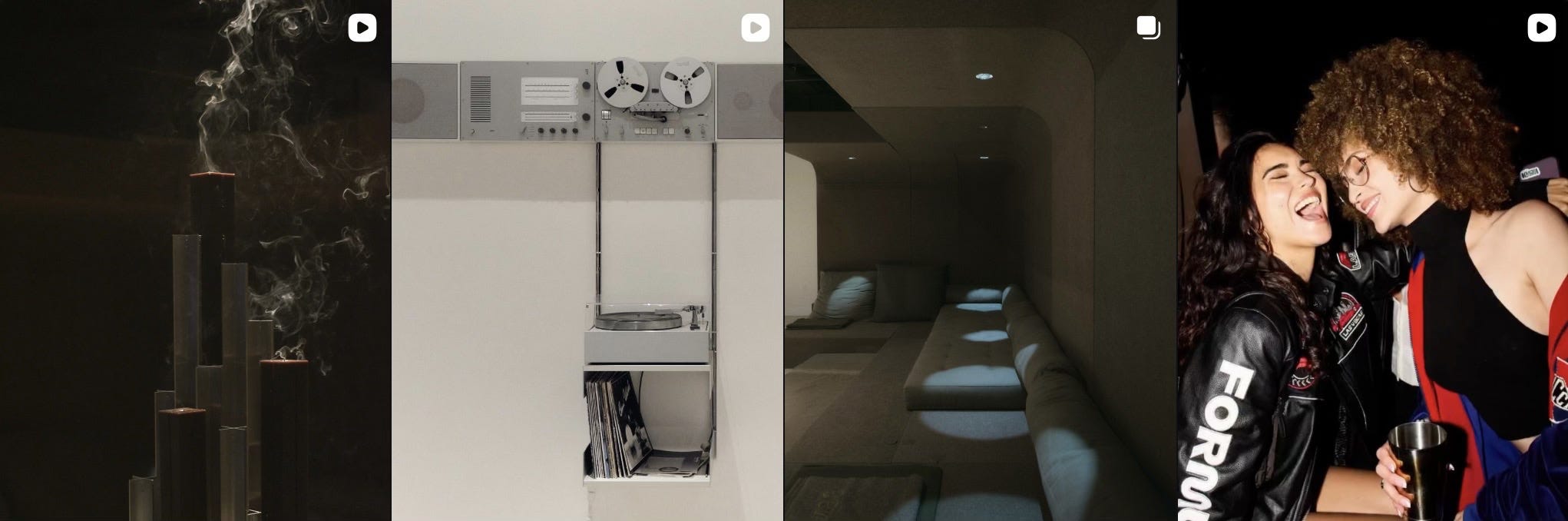
The first room was dimly lit, its edges made hazy by the slow drift of incense and smoke from AB+AC’s sculptural city (which doubled as a candle holder). The main feature was Rick Owens’s couch, looming over its audience by several feet. There was something oddly religious about this atmosphere, although I might have been caught up by the smell of frankincense and the soft clinks of Chrome Hearts necklaces as the person next to me tilted their head in contemplation. Two weeks ago, Basic Space had posted a post explaining the couch’s composition of “Batipan plywood and French wool army blankets” and to which a person in the comments section replied with just a word: “hard”. There was a loose circle of admirers, all clad in dark greys, blacks, and minimum three silver rings, standing in front of the monolith structure with their palms folded in front of their pelvis. We all looked at the couch. No one sat on the couch.
“A Woman’s Work”
The theme of the next room was the opposite. Well-lit fixtures, mirrors, mahogany and flowers; the shades of creams and beige were deliberately chosen to whisper West Village. There was a curated assemblage by HURS titled “A Woman’s Work,” featuring only female designers. My eyes immediately went to a Mariyo Yagi’s fringe lamp, its strands hanging silkily from ceiling to floor; it was hard to suppress an intrusive urge to run a hand across the strings and watch the fibers ripple. Elsewhere, a vase of white lilies curled elegantly over dark wood; an ornate silver combs by Jessi Burch sat dead center on a metallic chair; and Jacqueline Rabun’s magnifying glass was positioned perfectly on a Ruemmler bench.
Despite my adoration for the exquisiteness of these individual objects, I couldn’t help but feel slightly disappointed when consider the space as a whole. Stepping back, the room felt somewhat…sexless. A lone copy of The White Album by Didion was on the shelf, maybe to lend a deeper impression of femininity , but it barely registered as evidence of a woman’s presence.
Then again, maybe I’m too critical. The room wasn’t titled “A Woman Lives,” It’s “A Woman’s Work” interpreted by HURS. They just chose the approach of presenting the finished product rather than showing the working process, the mess, the evidence of labor. They portrayed femininity as a composed and untouchable - the interior design of a cool girl with “nyc / paris / tokyo” in her bio and weekly plans at the candle-lit bistro, small plates & natural wine. It just wasn’t my preference. Where’s the friction? The tension? Show me the effort, sweat, and the labor it takes to acquire taste.
We move from “A Woman’s Work” to Rodrigo Garcia’s sculptural sundials hanging vertically on wooden beams. If I were to liken Rick Owen’s couch to the insides of a gothic church, then the sundials (or “estudios” as Garcia calls them) reminded me of Cristo Redentor tanning under the Brazilian sunshine.
A few more steps away was multiple SS26 Bottega Veneta bags were pitched on top of 6AM Glass stools. A silent sentinel warily watches over these woven jewels, scanning each passerby. Upon meeting my eyes, they rightfully clock the fact that I would not be buying anything.
Take the picture! Take the picture!
I reach the art gallery. The largest square footage was occupied by Nick Thomm, and it was there, that without fail, came a constant stream of influencers and college students posing in front of his aura ring paintings, all of whom will then leave without another backward glance. I drifted to the other stalls, mentally bookmarking names for later research: Henry Galvin, Archer Defterios, Katie McGown, Alex Moore; these artists carried a sort of playfulness and emotional liveliness that I empathized more deeply with.
by Aeir
My head began to spin from all that I’ve seen — or more accurately, from all that I had smelt. Even before catching glimpses of Maison Margiela pinky rings, I could smell the $$$. You just knew that these people exclusively used Aesop soap and could correctly pronounce Loewe.
Three girls in Tank Air tops and Cartier bangles walked past, saturated in the test sprays of Wet Stone, “the first biomolecular scent by Aeir.” Aeir had taken over a narrow room shaped somewhat like a trapezoid. The lengths of the space converged at a thin strip of wall only few hands wide. On that sliver, Aeir had installed a single canister of their $169 parfum (only $169?). Due to the limited space and the crowd, I did not see the canister at first, and was genuinely curious as to why everyone was staring so intently at a blank wall.
Another couple wandered in, and I immediately recognized wafting of Thé Noir 29. I caught this wiggling thought by its head, and found myself briefly wondering - if I could place MM and Thé Noir 29 so quickly, what made me so different from the crowd I was deriding?

you can buy the house, but not the bed
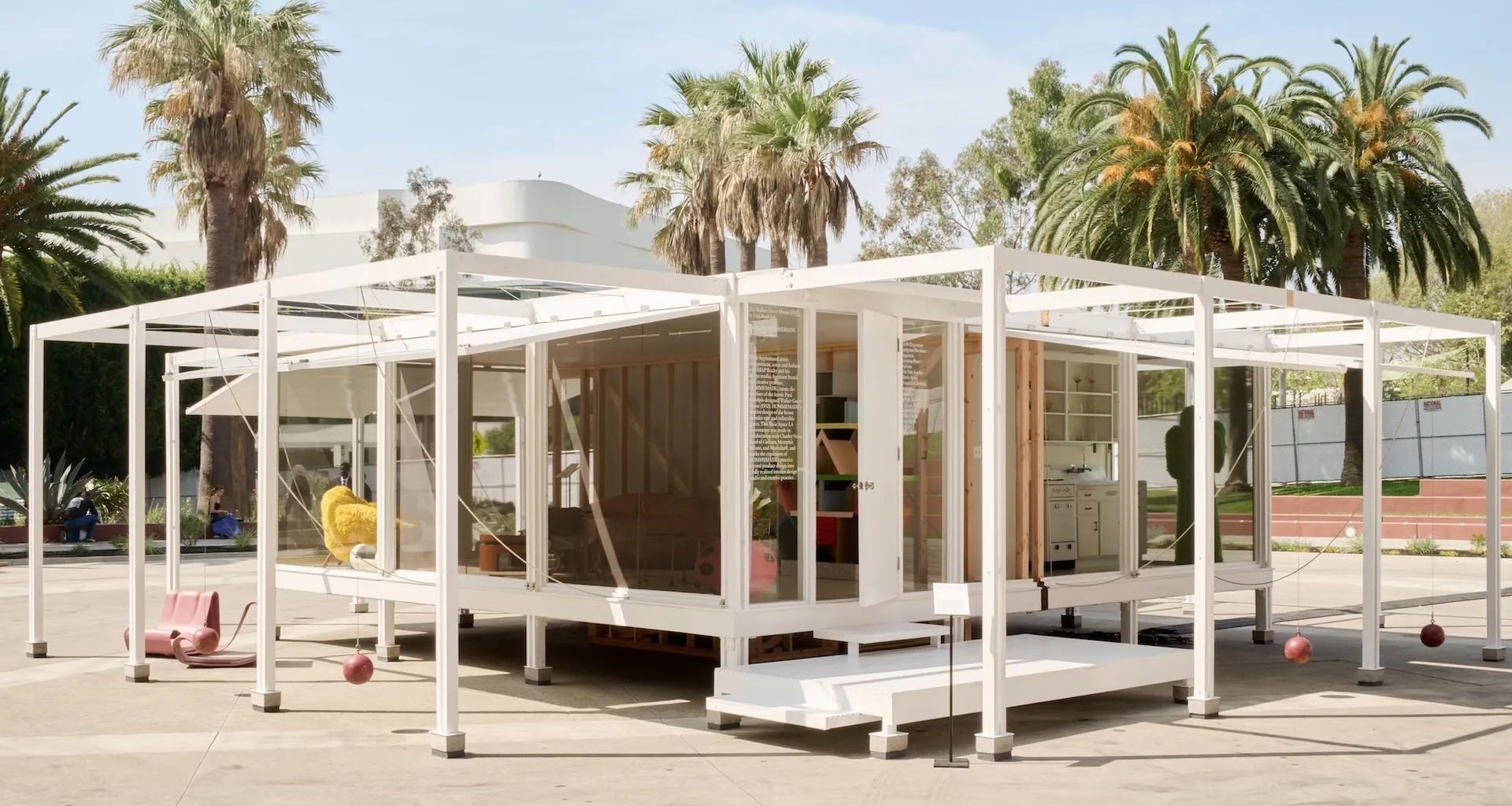
Having made our way around the floor, my last stop was outside, where Paul Rudolph’s Walker Guest House was. The 576-square-foot home had been moved from a dusty dungeons in Mojave Desert to be temporarily installed under the punishing LA heatwave. Likely it will be bought and placed back into another dusty garage. There were some signs of wear, but luckily, the interior got spruced up by Hommemade, A$AP Rocky design studio. There was a queue waiting to go inside so a man began to lower himself onto one of the chairs next to the house. Instantaneously, a staff materialized and rushed over. “You can’t sit on that, sir, it’s — it’s only for display.” There was a slight pause, as if he also heard the ridiculousness of his statement.
Ceci n'est pas une pipe. This is not a chair. I am reminded of the banana taped to the wall and that Tate Modern cleaner who mistook an art installation for trash and scraped it away.
Proudly, Basic Space told us, you can buy anything you clap your eyes on! The Walker House is yours for just $2 million. Or if you want the fuzzy cactus in the kitchen. Or the hanging art of SpongeBob crying. Everything from the toilet cover to the kitchen sink. The bed is the sole exception. “The bed, owned by A$AP Rocky, is the only item in the guesthouse not for sale.”
I might start crying or laughing, or both.
You can’t sit here, sir.
Basic.Space is admirably transparent about its ambitions. The event states clearly that it is “invite only - RSVP needed - for members.” Their website writes “obsessively curated, and unapologetically commercial.” Basic.Space is self-aware of its contribution to consumerism because it’s not meant to be a museum, it’s a business. It wants people to buy, and even better if those people are influencers and celebrities that will go on to post about their obtained wares.
I actually don’t have a problem with Basic.Space despite my sarcasm and wryness. They are trying to make shopping IRL again. That is exciting! Especially with art/design/fashion, it is a poignant experience to experience in person rather than through a screen. Basic.Space has gathered lovers, buyers, and people who genuinely appreciate the value of the objects being shown. But bad fishes do slip in. Alongside the art lovers and serious buyers, there are people only there for the hype. These people are just there to be seen and photographed. They will take a selfie in front of Thomm’s pieces and walk away without a thought beyond, “wowww, pretty colors”. They are neither there to have a dialogue with the artists nor are they there to buy. Unfortunately, I don’t have a solution. Pop-quiz at the door? I don’t know!
Ultimately, I don’t think Basic.Space is the problem. In fact, seeing the number of people that showed up, Basic.Space has demonstrated LA’s desire for these sorts of experiences. We should have more events like this, albeit with less focus on commercialism. There is a want for temporary spaces filled with strong, contrasting personalities & tastes, where artists, curators, and audiences share physical air (sorry, I meant to say Aeir) instead of algorithmic space.
Basic.Space is magical because it is something that established museums cannot do: rotating sensibilities, its once-a-year scarcity, and the sense that each edition is authored by a different mind. Despite all of my wryness and sarcasm, I truly loved coming. I now have the name of five new artists to follow and a renewed hunger for life outside of digital culture. It was a wonderful opportunity to speak to the designers and meet fellow art lovers that are there out of true appreciation. I just wish that there was less photo ops blocking my view.
And that I sat on Rick Owen’s couch.